
Intimacy 2:
A Study in Presence
Two people meet—each carrying a different pull. One shaped by what lingers behind, the other reaching toward what has not yet arrived. Between us, pushing and pulling unfold; the body learning to stay present while opposing forces remain.
I met Melissa in the fall of 2023 at ConnectArte Espacio Multidisciplinario in Tijuana, Mexico.
I was teaching an open technique class that she attended. Afterward, she and her colleagues from SISU Danza Compañía de Danza invited me to choreograph for their company. I said yes without hesitation.
That spring, we spent five weeks working together. During that process, I found myself drawn to Melissa—not only for her dancing, but for the way she moved through her life. There was ambition there, but also steadiness. A quiet way of carrying things. Our relationship at the time was light and sisterly. We shared space easily, but our lives moved alongside each other rather than deeply together.
Back then, she spoke about wanting to move to New York. I remember thinking it was a beautiful, distant idea—something admirable, but far from my own path. I had no sense that I would eventually find myself there, too.
Time passed. Then, unexpectedly, I began running into her again—this time in the locker rooms at Gibney. Not only were we now in the same city, but we were also taking many of the same contemporary classes. For a while, our meetings were brief: passing smiles, quick greetings, the small recognition that comes from seeing a familiar face in a large place.
One day, we both arrived early to class and finally had the space to sit and talk. The conversation unfolded easily, and before long, we made a simple decision to collaborate. And just like that, we began our creative process.
Working on this duet gave us something we hadn’t quite had before—time. Time to listen, to share stories, to understand the quiet weight each of us was carrying. She spoke about living far from home, about the complicated tenderness of building a life in a new place while knowing that the ground beneath it might not be permanent. The effort of adjusting to a new culture. The slow work of creating belonging.
Those feelings were familiar to me. In different ways, in a different geography, I had lived them too. Through the process, our conversations folded into the choreography, and our choreography folded back into conversation. What began as a collaboration gradually became something closer.
This time together feels particular because it exists inside a window. Her visa will soon expire, and she will return home. In that way, the work carries a quiet awareness of impermanence.
The duet became a kind of marker for her time here—a way of holding the experience in the body before it changes again. And perhaps also something else: a small gesture forward, a way of leaving the door open for her to return.
“What I seek is not a place, but the presence that makes a place.”
Pita Amor
What aspect of Intimacy do we struggle with?
-
I am living between places. What I left behind no longer feels the same, yet what I am building here has not fully settled. When I return, I recognize things, but they don’t meet me in the same way. And here, even as I create a life, there is a constant awareness that it may not be permanent.
I carry a deep connection to home alongside the reality of distance. My relationships, my language, my sense of self—they stretch across borders. I am learning how to belong in a new environment while holding the weight of where I come from, and the quiet guilt of being away from it.
-
I am living inside a kind of reaching. There is often something just ahead of me—an idea, a person, a future—that I move toward, but never fully arrive at. The distance is subtle, but constant. It keeps me in motion.
I am learning how to be with what is here, without drifting too far into what could be. Desire and imagination have a way of pulling me forward, shaping how I experience closeness. I am practicing presence—staying with what is in front of me, even as part of me continues to reach beyond it.
How can two bodies remain present with one another while being pulled in different directions—between what lingers behind and what calls them forward?
-
We began by developing individual solos rooted in opposing directional forces. One body moved with a sense of being pulled backward, as if something behind continued to hold weight and influence. The other moved forward, reaching into space with a subtle but persistent draw. These phrases were not fixed in meaning, but grounded in sensation—gravitational pulls that shaped timing, alignment, and effort. Each solo became a physical landscape of orientation: where the body leans, what it resists, and what it follows.
-
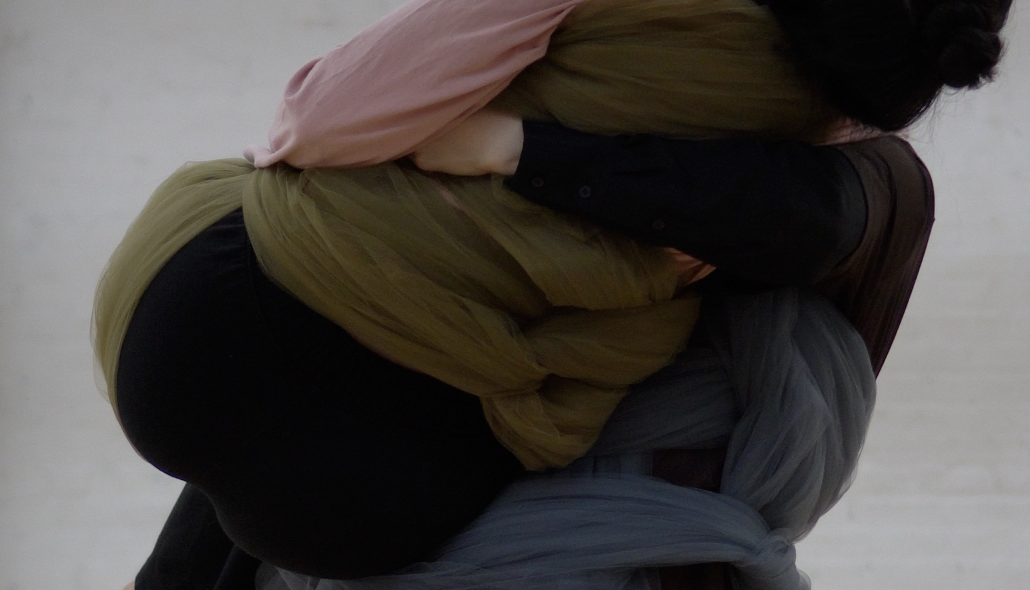
The solos were then brought together and intertwined, with tulle connecting our bodies. The material functioned as an extension of the skin, heightening sensitivity to tension, distance, and touch. As we moved, the tulle revealed the constant negotiation between us—when one pulled, the other felt it; when one yielded, the other adjusted. At times, the connection blurred the boundaries between two bodies, creating the sense of a single, shared organism shaped by opposing forces.
-
We introduced movement scores to structure moments within the work—simple frameworks that allowed specific qualities of intimacy to surface. One score centered on lifting and holding: how we take weight, how long we sustain it, and when we release it. These actions were approached not as feats of strength, but as acts of attention and care. Within these scenes, intimacy emerged through duration, effort, and the quiet decisions made between two bodies in relation.
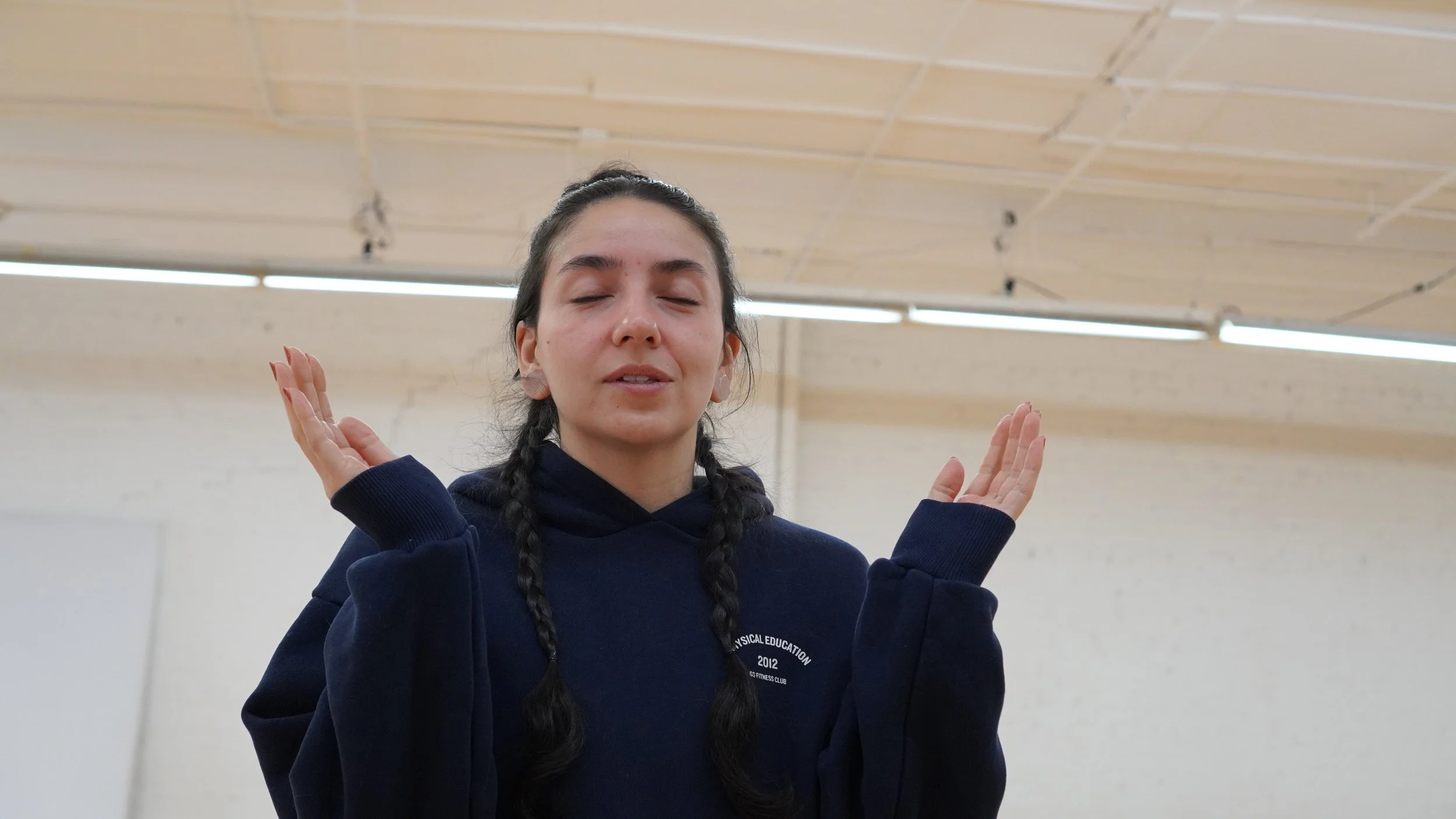
The photographs and videos were taken during the creative process by Melissa and me.